
 Download plain text
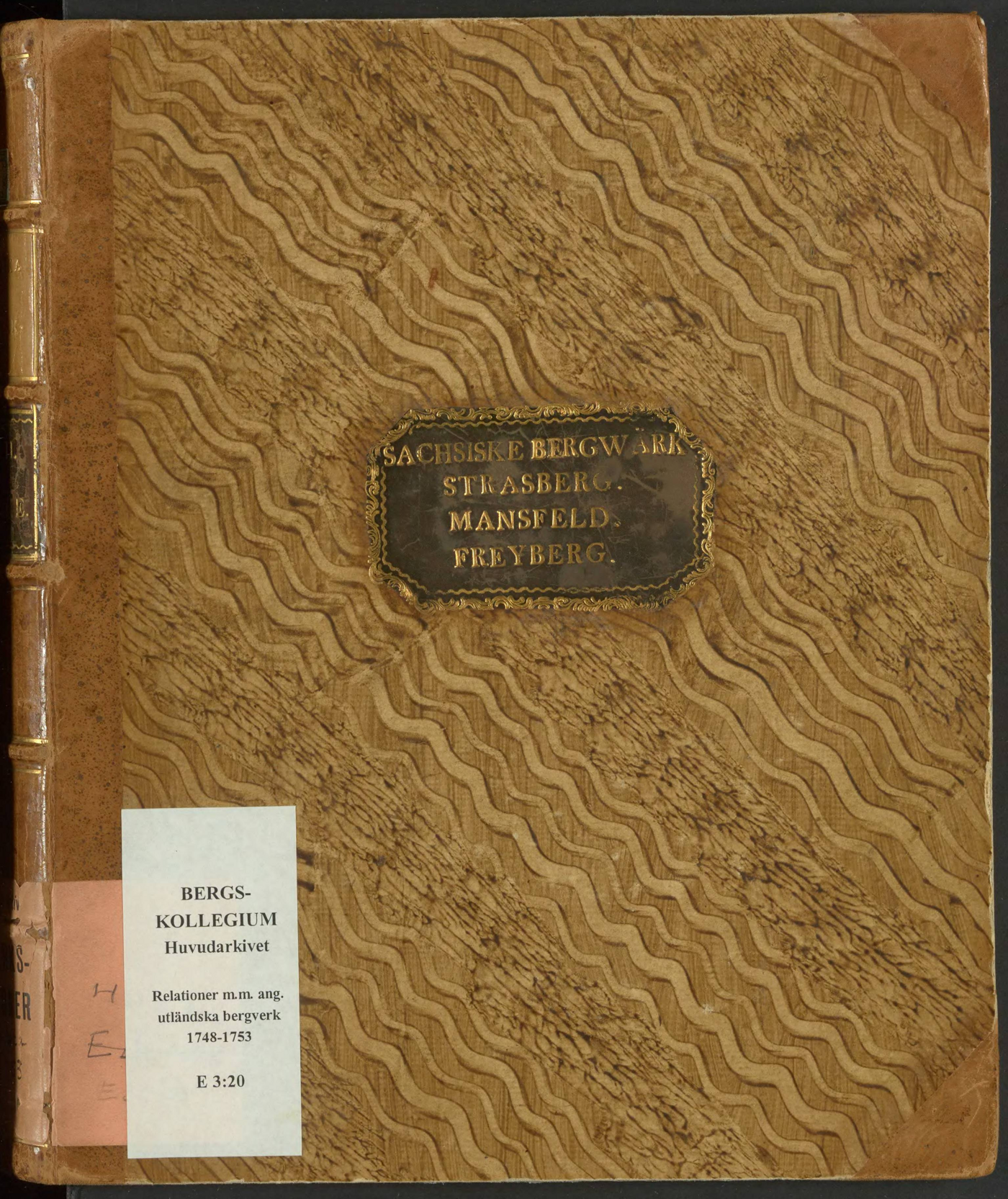
Alexander Funck Bd. 2 (1748–1753)
Data quality
- The transcription has not been fully proofread and may contain OCR errors.
- Place names in the text have not been systematically marked.
- Marked places may not yet be linked to coordinates in the gazetteer.
- Illustrations may be incomplete or not yet reviewed.
- This volume has not been editorially approved for publication.
This report was compiled by Alexander Funck (1716–1797). Trained within Bergskollegium and closely associated with Daniel Tilas, Funck belonged to a generation that sought to combine practical mining experience with increasingly systematic geological observation and analysis. During his extensive continental travels of 1748-1753 he visited many of the most important mining regions of Central Europe, producing detailed studies intended to advance Swedish mining science and mining administration.
The present volume forms a direct continuation of Funck's report on the Harz mining districts. Whereas the first volume focused on the mines of the Harz Mountains and was largely organised around questions of mine construction, drainage, mining methods and ore-bearing veins, this second report follows Funck into the great mining regions of Saxony, Mansfeld and Freiberg. It reflects his growing interest not only in individual mines but in the organisation of entire mining regions, their geological structure, administrative systems and metallurgical processes.
Like the Harz report, the manuscript is highly analytical and differs markedly from the earlier travel accounts of Edmund Gripenhielm and Henric Kalmeter. Gripenhielm described foreign mining regions and technologies around 1700; Kalmeter combined mining observations with wider investigations of manufactures, trade and economic policy. Funck, by contrast, is concerned above all with mining systems, geology and mine management. The volume repeatedly moves from observation to comparison and from comparison to general conclusions about mining practice.
Particularly extensive sections are devoted to the silver-mining districts of Freiberg, Brand-Erbisdorf, Halsbrücke, Hohe Birke, Andreasberg and other centres of Saxon mining. Funck analyses ore veins, geological formations, intersections between veins, faulting, displacements, water-management systems and the practical consequences of different mining methods. He pays exceptional attention to the structure and behaviour of ore deposits underground, often discussing individual veins over many pages.
A second major theme is metallurgy. The manuscript contains detailed descriptions of ore dressing, roasting, smelting and silver extraction, particularly in Freiberg and the Mansfeld copper-shale district. Funck discusses different smelting regimes, lead smelting, silver refining, sulphur recovery, copper production and the treatment of low-grade ores. Compared with the first Harz volume, there is significantly greater emphasis on metallurgical processes and the organisation of smelting works.
One of the most distinctive features of the report is its sustained comparison between mining regions. Funck explicitly contrasts Saxon, Harz and Swedish practices, evaluates their relative advantages, and comments critically on both successful and unsuccessful solutions. He devotes particular attention to drainage adits, mine support systems, shaft construction, underground filling methods and ore-processing techniques, often presenting alternative approaches alongside his own judgement of their effectiveness.
The report also provides valuable insight into the economic organisation of eighteenth-century mining. Funck records the structure of mining companies (Gewerkschaften), the financing of mines, production figures, mine taxation, labour arrangements and the administration of Bergämter. Particularly noteworthy are the extensive tables tracing the fortunes of individual mines across several decades, documenting their periods of prosperity, decline, closure and revival. These materials make the manuscript an important source not only for mining history but also for the history of mining administration and investment.
In comparison with the first Harz volume, this report is somewhat less concerned with mine architecture and more interested in the broader workings of mining regions and metallurgical systems.